



Cat tree or scratching post? Choose for the way your cat plays
Before you measure the room, watch where your cat puts their front paws. A cat that stretches straight up the arm of the sofa is asking a different thing of its furniture from one that climbs onto the back cushion to watch the street. One needs a good place to scratch. The other might genuinely use a tree. If yours does both, look for both jobs in the same piece.
What does your cat already choose?
For a cat that scratches standing up, look for a continuous stretch of scratching surface. The height printed on the box is the height of the whole item. A base, toy or top platform can take up part of it. The Rex & Roxy 80cm post is a useful straight post to compare with a tree that breaks up the same space into shorter sections.
If the favourite spot is a cushion by the window, start with the resting platform instead. Is it broad enough for the way your cat sleeps? Can they get there from the floor, and get down without leaping onto furniture? A tree with an appealing top perch is only useful if your cat enjoys the route.


Compare three shapes, not just three heights
| Option | What you are buying it for |
|---|---|
| 80cm scratching post | An upright place to stretch and scratch. Pick this over a tree if a sleeping platform is unlikely to get used. |
| 59cm compact cat tree | A smaller tree with a resting spot. Compare the base and cubby with the available corner rather than choosing it on height alone. |
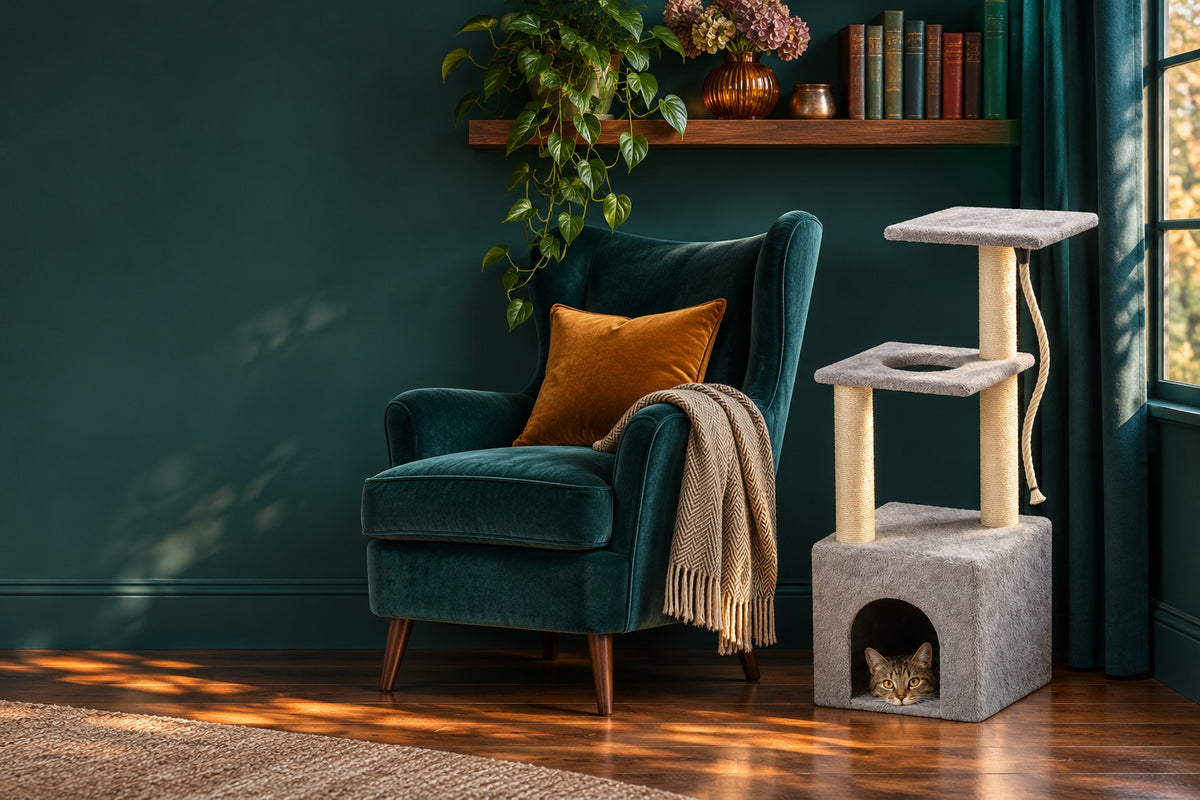
| 90cm cat tree | A cubby, an intermediate platform and a raised perch. Look at the size of each resting place as well as the climb between them. |
Notice that the straight post is taller than the compact tree. That does not make it a better lookout: there is no equivalent perch. Equally, buying a taller tree does not guarantee a longer uninterrupted scratch. Choose the feature your cat will use, then compare measurements for that feature.
Try the footprint before you order
Take the base dimensions from the listing and mark the corners on the floor with bits of paper. Open the nearest door, pull the curtains and walk past carrying a laundry basket. A corner that looks empty in a photo can be the busiest part of the room in practice. Allow room for any platform that sticks out beyond the base.
Now measure a spot your cat already sleeps on. If they like to sprawl across a cushion, compare that space with the platform, not the footprint on the floor. For a cubby, the entrance and interior are the useful measurements. If the listing gives only the overall height, ask us about the perch or opening rather than guessing from a picture.
Where to put it so it gets used
If the sofa arm is the scratching spot, trying the post beside that arm makes more sense than putting it in a spare room. For a cat that watches the garden, stand where you plan to put the tree and look towards the window at perch height. A solid panel, closed blind or tall radiator can turn a promising lookout into a view of the wall.
Two cats need not want the same spot. Watch whether they already share a windowsill or take turns. In some homes a post in one room and a resting place in another will see more use than a single taller tree. For a cat that dislikes climbing, a low, easy approach can be more inviting than another level.
A last check on the details
Look at the base on the floor you actually have, and follow the assembly and fixing instructions for that model. Check that you can reach inside a cubby for cleaning and get to the fittings later. If your cat likes to stretch out heavily against a post, pay particular attention to stability rather than judging by how substantial the carpet covering looks.
Choose a post for the stretch, a compact tree for a favourite corner, or a larger tree for a cat that will use the climb as well as the perch. Then use the actual dimensions to settle the decision. Shop cat trees and scratching posts.